Showing posts with label WDET-FM. Show all posts

Friday, December 20, 2013

Yuletide By the Fireside, and Joyful Memories There

It's an established tradition at In Aurem A2D to use holidays as opportunities for Surface to Air Full Circle music challenges. Our last was on Valentine's Day.

You know the drill. (Connection between our game and the WDET-FM Music Head fundraiser is in our first challenge.) Starting with a particular song, chart a path along associated metadata to create a connected playlist; but at some point, reverse course and return along a different metadata path to arrive full circle back at the starting song, in "about an hour" of running time. Bonus points if you only use songs from your personal library (as I always do).

That bonus may get harder to achieve over time, if the trend continues away from music ownership and personal libraries to music access and personal playlists via streaming services.

To celebrate Christmas in the USA, our starting/ending song is Vince Guaraldi's "Christmas Time Is Here" from the soundtrack to A Charlie Brown Christmas. After ephemeralizing my own LP copy of Charlie Brown to weightless high-res digital, I donated it to the Library of Congress in 2012.

Full-size table here. Annotated table with metadata associations here.

For the first time, a list clocks in at 60 minutes on the nose. As a bonus, we included two consecutive Everly Brothers covers that both had other relevant metadata connections and were recorded by male/female duos. Previous lists can be found in the Surface to Air 2012 Retrospective.

Merry Christmas!

            Vinyl-to-Digital Restoration #63            

Artist: Linda Ronstadt
Title: Get Closer
Genre: Rock
Year: 1982


In an earlier piece on sustainable business models, we profiled a vinyl-to-digital restoration of an example of Linda Ronstadt's mid-career collaboration with Nelson Riddle. Get Closer is a title from her earlier "rocker chick" period, the music that got her elected to the Rock -n- Roll Hall of Fame Class of 2014. Well-deserved.

© 2013 Thomas G. Dennehy. All rights reserved.

Wednesday, February 13, 2013

That Was the Day Before Love Came To Town

It's an established tradition at In Aurem A2D to use holidays as opportunities for Surface to Air Full Circle music challenges. Our last was on Thanksgiving.

[Photo credit: Yehia-elal​aily]

You know the drill. (Connection between our game and the WDET-FM Music Head fundraiser is in our first challenge.) Starting with a particular song, chart a path along associated metadata to create a connected playlist; but at some point, reverse course and return along a different metadata path to arrive full circle back at the starting song, in "about an hour" of running time. Bonus points if you only use songs from your personal library (as I always do).

That bonus may get harder to achieve over time, if the trend continues away from music ownership and personal libraries to music access and personal playlists via streaming services.

To celebrate Valentine's Day in the USA, our starting/ending song is U2's "When Love Comes to Town" (featuring B. B. King).

Full-Size table here. Annotated table with metadata associations here.

A worthy effort at almost exactly an hour (within the margin of error on the published running times). However, it makes more use of direct song title to song title transitions than previous lists, something to watch in the future. Previous lists can be found in the Surface to Air 2012 Retrospective.

While you listen to any or all of the tracks along our journey, check out this Brain Pickings thought piece,  Calculating the Odds of Finding Your Soulmate. Happy Valentine's Day!

            Vinyl-to-Digital Restoration #52            

Artist: U2
Title: Rattle and Hum
Genre: Rock
Year: 1988


Music buyers who only know an industry dominated by iTunes can't imagine a time when you needed to buy an entire double LP set just to get the one or two tracks you really wanted. The feature film Rattle and Hum may have been negatively characterized by some critics as "an accidental mockumentary," but the performances are solid. For me, the highlights are "When Love Comes to Town," a hard-charging blues duet with B. B. King, and the equal-parts plaintive and haunting "All I Want Is You."


© 2013 Thomas G. Dennehy. All rights reserved.

Monday, November 19, 2012

Thank You For Sending Me an Angel

It's getting to be a tradition at In Aurem A2D to use holidays as opportunities for Surface to Air Full Circle music challenges. Our last was on Labor Day.

You know the drill. (Connection between our game and the WDET-FM Music Head fundraiser is in our first challenge.) Starting with a particular song, chart a path along associated metadata to create a connected playlist; but at some point, reverse course and return along a different metadata path to arrive full circle back at the starting song, in "about an hour" of running time. Bonus points if you only use songs from your personal library.

That bonus may get harder to achieve over time, if the trend continues away from music ownership and personal libraries to music access and personal playlists via streaming services.

To celebrate Thanksgiving Day in the USA, our starting/ending song is Talking Heads' "Thank You For Sending Me an Angel."

Full size table here. Annotated table with metadata associations here.

We're getting a little lengthy at over 61 minutes (longest running time for a list to-date). But this list appeals to me for metadata associations enlisting wordplay that we have not explored in pevious exercises.

HappyThanksgiving!

             Vinyl-to-Digital Restoration #46             

Artist: Talking Heads
Title: More Songs About Buildings and Food
Genre: Alternative
Year: 1978


More Songs About Buildings and Food is the second album by Talking Heads. It was the first in a series of three produced by Brian Eno. In 2003, the album was ranked number 382 on Rolling Stone magazine's list of the 500 greatest albums of all time. I bought it after seeing Talking Heads peform "Artists Only" and "Take Me to the River" on Saturday Night Live. Before MTV made music on TV ubiquitous, appearing as the musical guest on SNL was a significant milestone for an act.


© 2012 Thomas G. Dennehy. All rights reserved.

Sunday, September 16, 2012

Everything I Need to Know I Learned From the Hubble Telescope

Should a recording document reality as faithfully as possible, or should it improve upon or somehow transcend the music it records? Both, actually.

[Image Credit NASA, ESA, and the Hubble Heritage Team STScI/AURA)-ESA/Hubble Collaboration. Acknowledgement: B. Whitmore ( Space Telescope Science Institute) and James Long (ESA/Hubble).]

The topic is very much in the news. Organizations like Harvard University and public radio station WDET-FM Detroit have publicized plans to digitize their vast archives of interviews and live performances, both for preservation and for cloud accessibility. The Harvard archives include rarities like the first appearances of Joan Baez at Club 47 in Boston, so it is important to do right by the material. But what exactly constitutes a high-quality digital audio preservation process?

Consider the image from the Hubble Space Telescope above, showing the slow collision of two galaxies producing super star clusters. It's spellbinding, dramatic, but it isn't real. Space doesn't look like this.

Hubble images are triumphs of sensor fusion. They are made, not born. Images must be woven together using the incoming data from cameras in many different spectral bands, cleaned up and given colors that bring out features that eyes would otherwise miss. The images illustrate the wonders of the universe rather than documenting them.

[I wonder if the sound subjectivists who believe that lossy compressed audio is “just fine” also dismiss space exploration with sophisticated instruments, because they can see stars “just fine” with the naked eye.]

It may seem quite a leap, but a strong analogy exists between the production process for a Hubble image and a high-quality digital restoration process for analog source material. There are three fundamental steps in both:
  • Data Collection. The dramatic Hubble images have their source in high-resolution instrument data; do no less with your source audio.
  • Sensor Fusion. Use software tools to analyse the audio from multiple perpectives to execute operations to improve audio quality.
  • Presentation. Render the results in formats accessible to the intended audience(s).
When the process is complete, two products have been created. First, there is an archival recording that faithfully transfers the original analog recording, in all its flaws, to digital form. Also, there is a restored image of that recording as processed sound files that transcend the moment to reveal what may not have been originally apparent to the naked ear.

But how do you design these steps to achieve a high-quality result? There are five fundamentals:
  • Accuracy, with regard to the source material
  • Appropriateness and Adequacy, with regard to your processes
  • Consistency and Explicitness, with regard to your execution
In an upcoming three-part series, we’ll examine how to stay true to the five fundamentals in your project. Stay tuned.

[Originally published 2-February-2012. Revised and expanded.]

            Vinyl-to-Digital Restoration #15            


Artist: Pink Floyd
Title: The Dark Side of the Moon
Genre: Rock
Year: 1973


What other title could be more appropriate to discuss? DSotM presents a presentation challenge due to the extensive use of crossfades between tracks, making it hard to identify the instant where one track ends and the next one begins. They slowly collide with each other in passing. As with live albums, you'll be glad to have accurate high resolution sound data when confronted with a crossfade to zoom way in to make a precise cut at your decision point.

© 2012 Thomas G. Dennehy. All rights reserved.


Friday, August 31, 2012

All Labor That Uplifts Humanity Has Dignity and Importance

[Rivera Murals, Detroit Institute of Arts]
It's getting to be a tradition at In Aurem A2D to use holidays as opportunities for Surface to Air Full Circle music challenges. Our last was on the 4th of July.

You know the drill. (Connection between our game and the WDET-FM Music Head fundraiser is in our first challenge.) Starting with a particular song, chart a path along associated metadata to create a connected playlist; but at some point, reverse course and return along a different metadata path to arrive full circle back at the starting song, in "about an hour" of running time. Bonus points if you only use songs from your personal library.

That bonus may get harder to achieve over time, if the trend continues away from music ownership and personal libraries to music access and personal playlists via streaming services.

To celebrate Labor Day in the USA, our starting/ending song is Elvis Costello's "Welcome to the Working Week."

Full-size table here. Annotated table with metadata associations here.

We're getting a little lengthy at an hour and 49 seconds (longest running time for a list to-date). But this list appeals to me for metadata associations enlisting songwriter names that we have not explored in pevious exercises.

Happy Labor Day!

             Vinyl-to-Digital Restoration #41             


Artist: Elvis Costello
Title: My Aim Is True
Genre: Alternative
Year: 1977


My Aim Is True is the debut album by Elvis Costello. It was the first of five consecutive Costello albums produced by Nick Lowe. In 2003, the TV network VH1 named My Aim Is True the 80th greatest album of all time. In 2003, the album was ranked number 168 on Rolling Stone magazine's list of the 500 greatest albums of all time..


© 2012 Thomas G. Dennehy. All rights reserved.

Tuesday, July 3, 2012

The Fireworks are Hailin' over Little Eden Tonight

It's time for our next Surface to Air Full Circle music challenge.

You know the drill. (Connection between our game and the WDET-FM Music Head fundraiser is in our first challenge.) Starting with a particular song, chart a path along associated metadata to create a connected playlist; but at some point, you have to reverse course and return along a different metadata path to arrive full circle back at the starting song, in "about an hour" of running time. Bonus points if you only use songs from your personal library.

[Image: Detroit-Windsor fireworks.]

That bonus may get harder to achieve over time, if the trend continues away from music ownership and personal libraries to music access and personal playlists via streaming services. What is your relationship with music?

To celebrate Independence Day in the USA, our starting/ending song is Bruce Springsteen's "Fourth of July, Asbury Park (Sandy)."

Full-size table here. Annotated table with metadata associations here.

The list clocks in at one hour, seven seconds. Pretty good, I think — close enough to exactly an hour to probably be within the margin of error on the reported running time of the tracks.

Happy 4th of July!

             Vinyl-to-Digital Restoration #37             

Artist: Weather Report
Title: Heavy Weather
Genre: Jazz
Year: 1977


Heavy Weather was the first full album for Weather Report featuring bassist Jaco Pastorius. It registered significant sales upon initial release, and monster numbers for a jazz album. It even produced a hit single "Birdland,"now considered a landmark in the jazz-rock, or fusion, movement of the 1970s. I saw Weather Report on the Heavy Weather tour at the Royal Oak Theater in suburban Detroit. Even though concert start was delayed more than three hours due to a storm-induced power failure, the show went on.


© 2012 Thomas G. Dennehy. All rights reserved.

Tuesday, February 21, 2012

If You Don't Know Where You're Going, Any Road Will Get You There

Even if your metadata is not sufficiently rich to let you sort your music autobiographically, you can still have fun with it. Let's play a music association game.

[Image: Connect the Dots Music Festival, Beaumont TX]

WDET-FM in Detroit runs an annual event called Music Head. Starting with a song submitted from a listener, in-studio guests "connect the dots" among artists, titles, and musical collaborations to create playlists where each succeeding song is somehow connected to the previous song.

Unfortunately, the listening audience experience of Music Head is a lot of near-dead air as the hosts and studio guests hem and haw, battling the clock to navigate a journey that has no destination on a road that diverges in all directions at every decision point. How can you judge the value of any choice? If you don't know where you're going, any road will get you there.

Then, on her Essential Music show the following day, host Ann Delisi delivers a version of Music Head with a specific goal. Starting with a song previously submitted by a listener, she charts a path along associated metadata to create a connected playlist as before; but at some point, she has to reverse course and return along a different metadata path to arrive back at the starting song, and to come full circle in about an hour of running time. There's a real challenge.

To celebrate that challenge, here is the first Surface to Air Music Head Full Circle list. All songs come from my dematerialized music library:


Full-size table here. Annotated table with all the associations here.
What do you think? I intend to publish Full Circle lists from time to time. Readers are encouraged to submit song sugesstions via the Comment Form or via email. Let's collaborate on a journey.


            Vinyl-to-Digital Restoration #20            

Artist: Blondie
Title: Parallel Lines
Genre: Alternative
Year: 1978
More than five years before the Parents Music Resource Center (aka the "Washington Wives") advocated warning labels on physical music media for potentially objectionable content, the original LP release of Parallel Lines had the following label affixed to the shrink wrap: CONTAINS THE UNCUT, UNCENSORED VERSION OF 'HEART OF GLASS.' The line bleeped by radio station censors: "... it was a pain in the ass." Could anyone possibly be offended by it today?


            Vinyl-to-Digital Restoration #21            

Artist: Philip Glass
Title: The Photographer
Genre: Contemporary
Year: 1983
January 27, 2012 was the 75th birthday of composer Philip Glass. Among the tributes and retrospectives, the radio program Fresh Air ran an previously-unbroadcast This American Life conversation between Philip Glass and his cousin, host Ira Glass. For me, the highlight of the exchange was this quote: "Style is specialized technique. You can't have style until you have mastered technique."


© 2012 Thomas G. Dennehy. All rights reserved.

Sunday, January 29, 2012

Metadata For Miles and I Still Can't Sort My Music Autobiographically

Metadata indexes and catalogs your music library.
The care and attention required to prepare and "plate" an LP digitally forges an intimate bond with the material that is hard to duplicate with titles acquired on CD or by download. That bond should be reflected in the completeness of your metadata.

These are hard-won bits. After you've carefully repaired old wear-and-tear, meticulously isolated and labeled all the tracks, and studiously supplied metadata, it's hard to dismiss your newly-ephemeralized title as just another entry in the library.

In contrast, ripping a CD is a mindless task. There are now robots available to do it for you, stacks of discs at a time. Downloading titles has become so easy their arrival has little impact. After purchasing Kate Bush's 50 Words For Snow on high-resolution download, I had to remind myself a week later that the bits had yet to be played. I can't imagine that kind of detachment after finishing an LP transfer, just as I feel more invested in a meal prepared from scratch than I do ordering takeout.
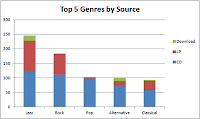
Metadata are the fields —  Artist, Title, Genre, Release Year, etc. — that enable media players to  index and catalog a music library automatically, providing constant-time access to all songs, no matter how large the collection. Virtually all CD ripping software has access to an online metadata source to supply the basics. In ephemeralizing LPs, the job of completing metadata falls to you, and the necessary time investment pays off.

In addition to the basic fields, jazz aficianados routinely complete the Contributing Artist field for a song (not universally available in online metadata sources) to track the dynamics of musicians moving from combo to combo. Enhanced metadata libraries with many extra fields for classical music are becoming available. Using metadata, collections can be sorted along any of the fields.

Yet, armed with all this information, I still can't sort my collection autobiographically — chronological by acquisition date. That information is deeply personal and uniquely revealing.

Imagine being able to go back and revisit your purchases, deduce what prior purchases or other factors influenced each decision. Did you buy artist B because s/he previously played with artist A on a title you liked? You could see exactly when particular artists came into your consciousness, or left it. An animated graph of the top 5 genres in your collection over time could show how your tastes evolved. The autobiographical sort would reveal more than any other slice through a person's library.

I'm sure there is someone reading this who has kept that information. In what personal ways do you catalog your music collection?

              Vinyl-to-Digital Restoration #13              

Title: Elaborations
Artist: Arthur Blythe
Genre: Jazz
Year: 1982
How did this album find it's way into my library? It would be a complete mystery unless you study the metadata. Most likely I sampled Arthur Blythe as a bandleader because he recorded as a sideman with Jack DeJohnette's Special Edition. Mr. DeJohnette, a 2012 NEA Jazz Master, is for me a trusted source due to his long association with Keith Jarrett and Gary Peacock in the so-called Standards Trio. But Mr. Blythe's presence in the library was "one and done," so Elaborations clearly didn't suit my taste at the time of acquisition. It may be a better fit now.

             Vinyl-to-Digital Restoration #14            

Artist: The Rolling Stones
Title: It's Only Rock 'n' Roll
Genre: Rock
Year: 1974
It wasn't until I ephemeralized this title, a birthday gift long ago in high school and long out of heavy rotation, that I realized that it contained the song, "Time Waits For No One." As an amateur creator of WDET-FM Music Head playlists, — which connect the metadata dots among songs — and restricting said lists only to content in my own library, I long sought to make the leap from artist Tom Waits to title, "Time Waits ..." And now I can.


© 2012 Thomas G. Dennehy. All rights reserved.